5 Key Benefits of Shopping at Salvage Grocery Stores (And Why Smart Shoppers Are Paying Attention)
Picture this: someone walks past a grocery store with a hand-painted sign that says "Bent Cans, Big Savings" and keeps walking. They figure it's probably sketchy, maybe stuff that fell off a truck, probably expired. So they head to the regular supermarket, spend $180 on a week's worth of groceries, and never think twice about it. That's a pretty common reaction. And it's also leaving a lot of money on the table every single month.
Salvage grocery stores, sometimes called bent-n-dent stores, scratch and dent grocery shops, or discount food stores, are one of the most genuinely underrated places to buy food in America right now. They carry products from real manufacturers and distributors, the food is safe to eat, and the prices are often 30 to 70 percent lower than what you'd pay at a regular grocery chain. Not a little lower. A lot lower.
Food costs have climbed steadily for the past several years and a lot of families are actively looking for ways to stretch their budgets without downgrading what they eat. That's exactly where these stores come in. This article walks through five concrete reasons why shopping at a salvage grocery store might be one of the smartest financial and practical decisions you can make for your household right now.
Benefit 1: The Savings Are Real, and They Are Substantial
Let's talk actual numbers for a second. A salvage grocery store typically offers products at 30 to 70 percent off standard retail prices. On a weekly grocery bill, that kind of discount adds up fast, and not in a vague, theoretical way.
Say your regular supermarket trip runs you around $175 a week for a family of four. That's roughly $700 a month, $8,400 a year. If you shifted even half of that spending to a discount food store and averaged just a 40 percent savings on those items, you're looking at saving around $1,680 a year. On groceries. Without changing what you eat.
Now, what actually makes these products cheaper? It's mostly cosmetic stuff, honestly. A lot of salvage inventory comes from overstock situations, where a distributor ordered too much of something and needs to move it. Other items have packaging that got dented or scuffed in shipping. Some products are approaching their best-by date but are completely safe to eat. None of these things affect the food inside. A can of black beans with a small dent on the side contains the exact same black beans as the pristine one sitting on a shelf at full price two miles away.
That distinction matters. A lot of people confuse "cosmetically imperfect" with "unsafe," and those are two completely different things. Best-by dates are quality indicators set by manufacturers, not safety deadlines set by regulators. Short-dated food is still food.
Bring a list of your regular grocery staples and compare prices to what you normally pay. Most people are genuinely shocked at the difference, especially on canned goods, cereals, snacks, and name-brand condiments.
Shopping for groceries on a budget doesn't mean sacrificing quality. It mostly means knowing where to look. And these places are worth looking at.
Benefit 2: You Can Find Brands You Actually Want
One thing that genuinely catches new shoppers off guard is the quality of brands they find at a salvage grocery store. This isn't generic store-brand territory. People walk in expecting off-brand canned goods and walk out with organic pasta, specialty hot sauces, premium protein bars, and sometimes even imported goods, all at a fraction of retail.
How does that happen? The sourcing process for these stores runs through a network of manufacturers, regional distributors, and retailers who need to move product quickly. Maybe a grocery chain over-ordered a seasonal item. Maybe a product line got rebranded and the old packaging needs to go. Maybe a pallet got damaged in a warehouse and the whole lot gets sold at a steep discount even though most of the individual units are fine. Salvage stores buy that inventory and pass the savings on.
Okay, and here's something that took me by surprise when I first started paying attention to this: the specialty and organic brands show up a lot. Products that normally sit behind a $9 or $12 price tag end up at these stores for $3 or $4. For people who care about eating clean but also care about their bank account, that's a genuinely useful combination.
Product selection rotates constantly. That's either a feature or a bug depending on how you think about shopping. If you like knowing exactly what you'll find every week, it takes some adjustment. But a lot of regular customers describe it more like a treasure hunt, and that framing actually makes sense. Every visit is different. You might find something you've never tried before at a price that makes it worth the experiment. That kind of variety keeps people coming back.
You won't always find the same thing twice. Stock in, stock out. That's just how it works.
Benefit 3: Shopping Here Is Actually Good for the Planet
Food waste in the United States is a staggering problem. Over 80 billion pounds of food gets thrown away every year in this country, and a huge portion of that food is completely safe to eat. It gets tossed because of cosmetic imperfections, overstocking, or because it's approaching a best-by date that doesn't actually indicate spoilage.
Salvage grocery stores sit right in the middle of that problem and do something useful about it. By buying up inventory that would otherwise go to a landfill and putting it back on shelves, these stores give food a second chance to actually be eaten. That's not a marketing angle. It's just what they do, operationally, every day.
For shoppers who care about their environmental footprint but also live in the real world with real budget constraints, this is a rare overlap. You don't have to choose between saving money and making a choice that reduces waste. At a bent-n-dent store or a damaged goods grocery, you're doing both at the same time.
This matters beyond the individual shopping trip. When millions of households consistently choose to buy food that would otherwise be discarded, it creates real pressure on the food system to reduce over-ordering, improve supply chain efficiency, and rethink how products get classified as "unsellable." Consumer behavior shapes industry behavior, eventually. Shopping at a food salvage store is one small, practical way to be part of that shift.
Short-dated products are not the same as expired products. Best-by and sell-by dates are manufacturer estimates for peak quality, not safety cutoffs. Many foods remain safe and perfectly good to eat well past those dates, especially canned goods, dry goods, and packaged snacks.
Benefit 4: Your Money Stays in Your Community
Most salvage grocery stores are not big chains. They're independently owned, usually by one family or a small team, and they're woven into specific neighborhoods and communities rather than operated from a corporate headquarters somewhere far away.
Spending money at an independent business has a different economic effect than spending it at a national chain. A larger share of each dollar circulates locally: it goes to local suppliers, local employees, local landlords, local taxes. That's not just feel-good economics. Research consistently shows that independent retailers recirculate a meaningfully higher percentage of revenue within their local economies compared to large chains.
Our directory currently lists 3,183 salvage grocery and discount grocery businesses across the country. Strong concentrations show up in Houston with 83 listings, Brooklyn with 61, Philadelphia with 46, and Los Angeles with 41. Those numbers suggest something real: these are not fringe operations. Salvage and discount grocery stores are a well-established part of the American retail food system, present in large cities and small towns alike.
When you search for a discounted grocery store near me and find a locally owned shop, spending there is genuinely different from driving to a big-box chain. Both save you money. Only one of them keeps more of that money in your own backyard.
Benefit 5: Customers Are Actually Happy With These Stores
Skepticism about salvage grocery stores is understandable. New shoppers sometimes worry about cleanliness, about whether the products are legitimate, about what kind of experience they're walking into. Those concerns are fair. And the customer review data does a lot to address them.
Across the 3,183 businesses in our directory, the average customer rating sits at 4.3 out of 5 stars. That is not a polite, low-engagement average. That reflects thousands of real reviews from people who showed up, shopped, and came back to share their experience. For context, a 4.3 average across a diverse directory of independent businesses is genuinely strong. Independent stores can't coast on brand recognition. They earn those ratings visit by visit.
Some specific businesses are worth calling out because the numbers are remarkable. Salvage Saviors in Katy, Texas has a perfect 5.0-star rating across 718 reviews. Re_ Grocery appears twice in the top ratings, with a 5.0 in Studio City, California based on 224 reviews, and another 5.0 in Los Angeles proper with 191 reviews. Getting 700-plus customers to all agree that your store is excellent is genuinely hard to do. That's not luck.
718 reviews. All five stars. Let that sit for a moment.
If you're searching for where to find discounted groceries and you're nervous about quality or experience, start with the reviews. Check ratings before your first visit. Look for stores with at least a hundred reviews and a rating above 4.0, and you're likely to have a solid experience. That's just a practical filter that takes most of the guesswork out of it.
By the Numbers: A Closer Look at the Industry
Directory data gives a useful snapshot of how many of these businesses exist and how shoppers feel about them. Here's a quick summary of what the numbers show.
| Business Name | Location | Rating | Reviews |
|---|---|---|---|
| Salvage Saviors | Katy, Texas | 5.0 ★ | 718 |
| Re_ Grocery | Studio City, California | 5.0 ★ | 224 |
| Re_ Grocery | Los Angeles, California | 5.0 ★ | 191 |
Note: House of Milner Jewelers (Philadelphia) and Hegwood's Towing LLC (Brandon, Mississippi) also appeared in the top-rated listings, which suggests the directory covers multiple business categories. For grocery-specific searches, filter by category to get the most relevant results.
Top cities by number of listings: Houston (83), Brooklyn (61), Philadelphia (46), Los Angeles (41). Those four cities alone account for a significant concentration of options, which means shoppers in those metros have real choice about which store to visit.
So, Is It Actually Worth Trying?
Salvage grocery shopping works best when you approach it with a little flexibility. If you go in expecting to find every item on your list every single time, you'll get frustrated. But if you treat it as a supplement to your regular shopping, or better yet, make it your primary stop and fill in gaps elsewhere, the savings are real and the experience is usually genuinely good.
Combining a weekly or biweekly trip to a discount food store with a smaller top-up run to a regular supermarket works better for most households than trying to do one or the other exclusively. You get the deep savings on pantry staples and packaged goods, and you pick up fresh produce or specific items elsewhere as needed. That approach consistently beats trying to stick to a single store.
For people who haven't tried one yet, the honest advice is simple. Find a well-rated scratch and dent grocery or bent-n-dent store near you, check the reviews, go once, and just see what's there. Most people who walk in skeptical walk out with a cart full of stuff they're glad they found.
Are salvage grocery store products safe to eat?
Yes. Products at salvage grocery stores are safe. Discounts reflect cosmetic damage to packaging, overstock situations, or proximity to best-by dates, not spoilage or contamination. Best-by dates are quality indicators, not safety cutoffs. Always inspect packaging before buying, just as you would at any store.
What kinds of products can I expect to find?
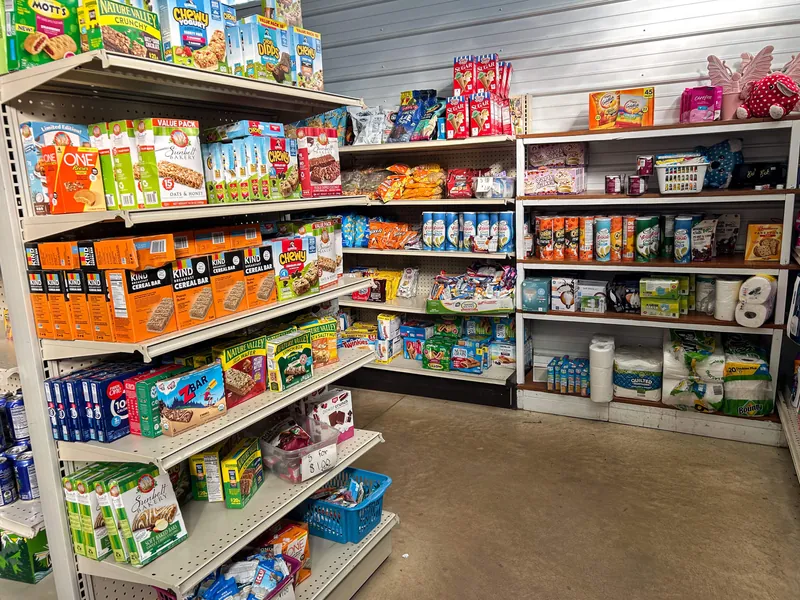
Inventory varies by store and changes frequently, but common finds include canned goods, dry goods like pasta and rice, cereals, snacks, condiments, sauces, beverages, and sometimes refrigerated or frozen items. Premium and organic brands show up regularly. Don't go expecting a specific list, but do expect to find useful pantry staples at steep discounts.
How do I find a good salvage grocery store near me?
Search our directory, filter for grocery or discount food stores, and check ratings and review counts before visiting. Stores with 100-plus reviews and ratings above 4.0 are a safe starting point. You can also search terms like "bent-n-dent store near me" or "scratch and dent grocery" to find local options.
Are these stores clean and well-organized?
This varies by owner, as with any independent retail business. High-rated stores in the directory consistently receive positive comments about cleanliness and organization in their reviews. Checking recent reviews before your first visit gives you a realistic picture of what to expect at a specific location.
Can I save money on name-brand items at these stores?
Yes, and this is one of the biggest surprises for first-time visitors. Name-brand and specialty products show up regularly because salvage stores source directly from manufacturers and distributors who need to move overstock or damaged lots quickly. Savings on name-brand items often range from 40 to 70 percent off retail.
Find a Salvage Grocery Store Near You
Browse our directory of 3,183+ discount grocery and salvage food businesses across the country. Check ratings, read reviews, and find a well-rated store in your city.
Search the Directory