How to Create a Functional Pantry with Salvage Grocery Finds
https://pub-9a4dedcce6dc4846a9c4647f79a2e5fc.r2.dev/salvage-grocery-stores/blog/how-to-create-a-functional-pantry-with-salvage-grocery-finds/hero-1771905811.webp
Picture this: someone walks into a bent-n-dent store for the first time, sees a slightly dented can of tomatoes, and puts it back on the shelf. They grab nothing. They leave. And they go pay full price at a chain grocery store two miles away for the exact same brand. That happens constantly, and it costs people real money they didn't need to spend. A dented can is not a dangerous can, and understanding the difference is where smart pantry building starts.
Salvage grocery stores, also called scratch and dent grocery stores, discount food stores, or sometimes just grocery outlet spots, have been around for decades. But they're getting more attention now, and for good reason. Food costs have climbed sharply over the past few years, and shoppers are looking for ways to cut their bills without eating worse. These places offer a real answer to that problem, not a theoretical one.
This article walks through how salvage grocery shopping works, what the data says about where these stores are thriving, and how to turn irregular, unpredictable hauls into a pantry that actually functions day-to-day.
What Is a Salvage Grocery Store and Why Should You Shop There?
Salvage grocery stores sell food that didn't make it to traditional retail shelves for reasons that have almost nothing to do with quality. A shipment arrives with boxes that got wet in transit. A manufacturer overproduces a seasonal item. A product gets discontinued and the remaining stock needs to move. Packaging gets a dent, a scratch, a torn label. None of that affects what's inside.
Products at a discount food store typically fall into a few categories: overstocked items from big manufacturers who need warehouse space, short-dated goods that are approaching but have not passed their "best by" dates, discontinued products being cleared out, and cosmetically damaged packaging where the food itself is completely fine. Okay, and sometimes there are odd lots, like a pallet of one specific flavor of granola bar that a retailer returned, which explains why you'll sometimes find 200 boxes of Blueberry Almond Crunch and nothing else in that brand. These places are unpredictable. That's kind of the whole point.
Savings at salvage grocery stores are not marginal. Shoppers routinely save 30 to 70 percent off what they'd pay at a conventional grocery store. On a $200 monthly grocery budget, that's potentially $60 to $140 back in your pocket just from shopping smarter. Brand-name pasta, canned beans, cooking oils, condiments, cereals, all available at prices that feel almost wrong when you first see them.
A "best by" date is a quality indicator set by the manufacturer, not a safety cutoff. Most shelf-stable pantry items remain safe to eat well past that date. "Use by" dates on perishables are more important to follow closely, but the canned goods and dry staples you'll find at salvage grocery stores are almost always perfectly fine to eat.
First-time shoppers worry about cleanliness and safety. That worry makes sense, but the data tells a different story. Across 3,183 listed salvage grocery businesses in our directory, the average customer rating sits at 4.3 stars. Shoppers are not just tolerating these stores out of financial necessity. They're actively recommending them. That average holds up across cities with very different demographics and markets, which suggests the quality experience isn't a fluke.
The State of Salvage Grocery Shopping, By the Numbers
3,183 salvage grocery businesses listed in one directory. That's not a niche market. That's a full industry.
Houston leads with 83 listings, which tracks given the city's size and its strong culture of value shopping. Brooklyn comes in at 61 listings, Philadelphia at 46, and Los Angeles at 41. Contrary to popular belief, discount grocery options aren't just a rural or small-town thing. Major metros are saturated with them, and competition between stores in those markets tends to drive prices even lower.
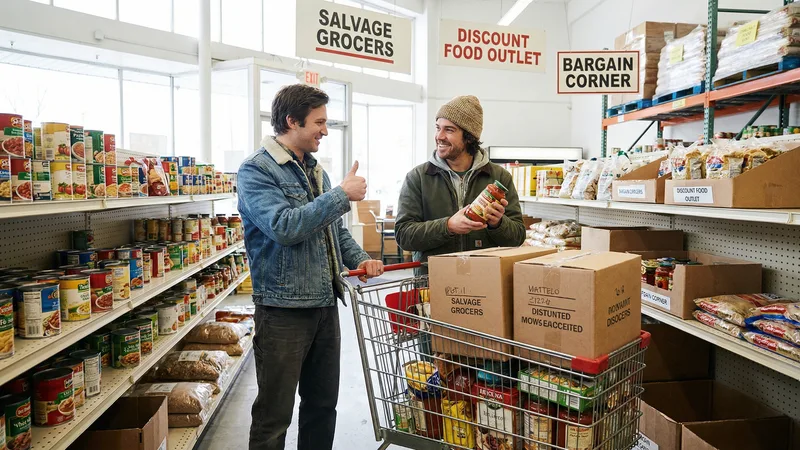
Worth noting: if you're searching "where to find discounted groceries" or "discounted grocery store near me" and coming up empty, you might be using the wrong search terms. These stores operate under a lot of different names, bent-n-dent, scratch and dent grocery, damaged goods grocery, food salvage store, and they don't always have "salvage" or "discount" in their actual business name. Browsing a directory rather than just Googling tends to surface more options.
Now here's where the ratings data gets interesting. Among top-rated businesses in the directory, Salvage Saviors in Katy, Texas holds a 5.0 rating across 718 reviews. That's a high volume of reviews for a perfect score, which is genuinely hard to maintain. Re_ Grocery shows up twice in the top rankings, once in Studio City, California (5.0 stars, 224 reviews) and again in Los Angeles (5.0 stars, 191 reviews), suggesting they've built a loyal following by making the salvage grocery experience feel intentional and clean rather than chaotic.
| Business Name | Location | Rating | Reviews |
|---|---|---|---|
| Salvage Saviors | Katy, Texas | 5.0 ★ | 718 |
| Re_ Grocery | Studio City, California | 5.0 ★ | 224 |
| Re_ Grocery | Los Angeles, California | 5.0 ★ | 191 |
Two other top-rated listings in the directory, House of Milner Jewelers in Philadelphia and Hegwood's Towing in Brandon, Mississippi, appear in the salvage grocery category data but are clearly different business types. That kind of directory overlap happens in broader category searches and doesn't change the overall picture. The grocery-specific businesses in the top ratings hold up well on their own.
How to Shop Salvage Grocery Stores Like a Pro
Forget the list. Or at least, loosen your grip on it.
Shopping at a discount food store with a rigid grocery list is a fast track to frustration. Inventory at these places changes constantly. What was there last Tuesday will not be there this Tuesday. Great shoppers go in with a category mindset, not a product mindset. "I need some kind of pasta" is a useful frame. "I need specifically penne" is not. Flexibility is what makes this model work for building groceries on a budget over time.
Evaluating products in-store is a skill that takes maybe two or three visits to pick up. For canned goods specifically, you want to look at a few things. Minor dents along the body of a can are almost always fine. Deep dents along the seam (the folded edge at the top or bottom) are a different story, that's where bacteria can get in if the seal is compromised. Bulging cans are a hard no, always. Rust on the outside doesn't automatically mean the inside is bad, but if the rust has eaten through to a hole, pass on it. That's it. Those are the rules, and they're not complicated.
Fine to buy: Small body dents, scuffed labels, slight discoloration on can exterior.
Inspect closely: Rust patches (check for holes), dents near seams.
Leave it: Bulging cans, seam dents, any can with a hole or leak.
For dry goods in damaged packaging, check whether the inner seal or bag is still intact. A crushed cereal box might still have a perfectly sealed inner bag. A torn pasta box where the pasta is just loose inside is still fine, you'll transfer it to a container at home anyway. Use your judgment on a case-by-case basis rather than writing off entire product types.
Visit often, and actually talk to the staff. Salvage grocery inventory turns over fast, and stores typically get new shipments on specific days of the week. Staff almost always know the schedule, and if you ask, they'll tell you. Showing up on delivery day gives you first pick of whatever came in. Some regulars at these stores treat it almost like a game, and honestly, that approach makes the whole process more enjoyable.
One more thing about frequency: going once a month and trying to stock up completely doesn't work as well as going every week or two with a smaller budget. Smaller, more frequent trips let you catch a wider variety of deals and avoid buying too much of one thing just because it was available that day.
Building a Functional Pantry with Salvage Grocery Finds
A functional pantry is not just a lot of food. It's food you can actually cook with, organized so you can see what you have and use it before it expires.
Salvage grocery stores reliably stock certain categories, even with rotating inventory. Grains and pasta show up constantly. Canned proteins like beans, tuna, and chicken are almost always available. Sauces, oils, condiments, baking supplies, shelf-stable snacks, these cycle through regularly. Building a pantry at a scratch and dent grocery store means prioritizing these core categories first, then treating specialty or interesting items as bonuses when you spot them.
Prioritize by cooking frequency. If you make pasta twice a week, stock pasta aggressively when you find it cheap. If you bake occasionally, grab flour and baking soda when they appear, but don't go overboard. A pantry that reflects how you actually cook beats a pantry that just looks impressive and has a lot of things you never touch.
Organization matters more for salvage shoppers than for people who buy the same items every week. Because you're bringing home different things each trip, it's easy for your pantry to become a chaos pile fast. A few systems help a lot. FIFO, first in, first out, means putting new purchases behind older ones so older stock gets used first. Sounds obvious. Almost nobody does it naturally without making it a habit on purpose.
Labeling with purchase dates takes about ten seconds per item with a marker and piece of tape. It's worth it. When you buy something at a discount food store, you might not cook with it for three weeks. That little date label tells you whether it's still comfortably within the window. Grouping by category, all canned proteins together, all pasta together, baking supplies in one zone, means you can see gaps and opportunities when you're planning trips to the store.
Clear bins or open shelving beats closed cabinets for salvage pantry organization. If you can't see it, you'll forget you have it. And forgetting you have something is how food goes to waste, which defeats one of the main benefits of this whole approach. A bin system that costs $30 at a home goods store will save you more than that in avoided food waste within a few months.
Tier 1 (stock aggressively): Cooking oils, pasta/rice/grains, canned beans, canned tomatoes, salt, basic spices.
Tier 2 (grab when you see it): Canned proteins, vinegars, soy sauce, pasta sauces, baking basics.
Tier 3 (bonus items): Specialty condiments, snacks, cereals, interesting imports.
Set a realistic budget for these trips. Salvage grocery shopping at a grocery outlet or discount food store works best when you treat it as a supplemental strategy, not your entire grocery plan. Something like 40 to 60 percent of your grocery budget for pantry staples from salvage stores, with the rest going toward fresh produce and proteins at whatever store works for you. That split gives you maximum savings on shelf-stable goods while keeping flexibility for fresh items that these stores carry less predictably.
Start small. One $20 trip to a salvage grocery store near you is enough to learn how the store works, practice evaluating products, and bring home a few genuinely useful items. From there, you scale up as you get comfortable. Trying to overhaul your entire pantry in one trip to an unfamiliar store is the wrong move. But building toward it over six to eight weeks? That's very doable, and the savings add up fast.
Frequently Asked Questions
Is it safe to buy food from salvage grocery stores?
Yes, in most cases. Salvage grocery stores sell food that is overstocked, discontinued, short-dated, or cosmetically damaged. None of those conditions make food unsafe on their own. Use the basic can inspection rules (no bulging, no seam dents, no holes from rust) and check "best by" dates against your expected timeline for using the item. Shelf-stable goods like pasta, rice, canned goods, and oils hold up well past their printed dates.
What is the difference between "best by" and "use by" dates?
"Best by" dates are quality indicators set by manufacturers. They tell you when the product is expected to be at peak flavor or texture, not when it becomes unsafe. "Use by" dates on perishables are more critical and should be followed more strictly. Most of what you'll find at a discount food store is shelf-stable, so "best by" dates are the main thing you're reading, and a few weeks or even months past that date is usually fine for dry goods and canned items.
How do I find salvage grocery stores near me?
Search terms like "bent-n-dent store," "scratch and dent grocery," "discount food store," or "damaged goods grocery" will surface different results than just "grocery store." Directory searches tend to work better than standard Google searches here because these businesses don't always use obvious names. Our directory lists 3,183 businesses, with strong concentrations in Houston (83 listings), Brooklyn (61), Philadelphia (46), and Los Angeles (41).
How often should I shop at salvage grocery stores?
Every one to two weeks works better than monthly big trips. Inventory turns over fast, and more frequent visits mean you catch a wider range of deals. Once you know which days new shipments arrive (ask the staff), you can time your visits to get first pick of fresh stock.
Can I build an entire pantry from salvage grocery shopping?
Most of a pantry, yes. Shelf-stable staples, grains, pasta, canned goods, oils, condiments, baking supplies, show up reliably at these stores. Fresh produce and proteins are less predictable. A split strategy works well: use salvage stores for 40 to 60 percent of your grocery budget covering pantry staples, and fill in fresh items elsewhere.
Find Salvage Grocery Stores Near You
Browse our directory of 3,183+ salvage grocery businesses across the country. From Houston to Brooklyn to Los Angeles, discount grocery options are closer than you think.
Search the Directory